
For animal professionals, understanding feline communication isn’t optional; it’s a core safety skill.
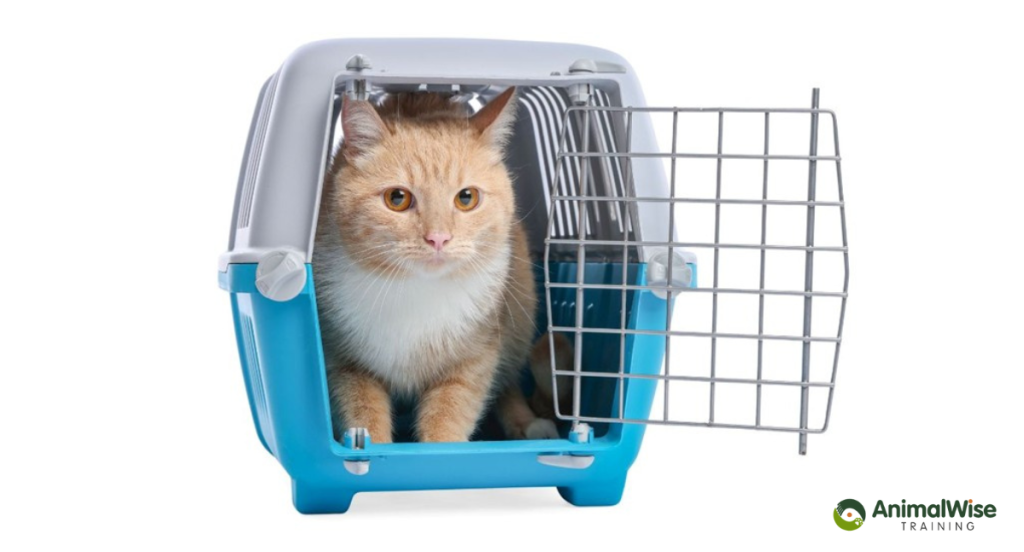
For anyone working with cats in animal management, shelters, or veterinary practice, the ability to read subtle shifts in body language is not just helpful — it is a core safety skill.
Cats can escalate quickly when overwhelmed, frightened, or unable to escape. Many bites and scratches occur not because a cat “turned without warning,” but because early signs were overlooked during busy, pressured interactions.
Across all workplaces, from a council ranger scanning for a microchip, to a shelter team member conducting feeding rounds, to a vet nurse handling a cat for a blood test, safer handling starts with understanding how cats communicate stress, fear, and rising arousal.
This article mirrors the format of our dog body-language blog, but focuses specifically on feline behaviour and their unique escalation patterns. The goal, as always, is to show what good observation looks like — and how professionals can intervene early to reduce risk and improve welfare.
Why Cat Body Language Matters in Professional Settings
Cats experience the world through a combination of previous learning, genetics, and what is happening in their environment right now. For many animals entering shelters, ranger vehicles, or vet clinics, everything about the situation is unfamiliar. The smells, sounds and handling procedures can rapidly escalate stress.
There are many definitions of stress, however, it can be helpful to view stress as the animal’s psychological, physiological and behavioural response to a perceived threat. Importantly, stress accumulates. A cat may cope initially, but repeated or intense triggers — transportation, being removed from hiding, restraint for procedures, exposure to dogs, loud noises, or unfamiliar people — can push them further up the Emotions Escalator.
In these environments, handlers must continuously ask:
“Where is this cat right now on the Escalator — and what do I need to adjust?”
Such moment-to-moment assessment is central to continuous and dynamic risk assessments, enabling handlers to intervene early and avoid the need for restraint tools or PPE, which can increase fear and escalate behaviour in many cats.
The “Emotions Escalator”: A Practical Framework for Predicting Risk
The Emotions Escalator utilises a traffic light analogy to illustrate the relationship between a cat’s arousal level (vertical axis) and the potential for aggression (horizontal axis) . As arousal level increases, so too does the risk to handlers. What appears as a mild, manageable behaviour in one moment can very quickly tip into high arousal, flight, freeze, or fight if early signs are not recognised.
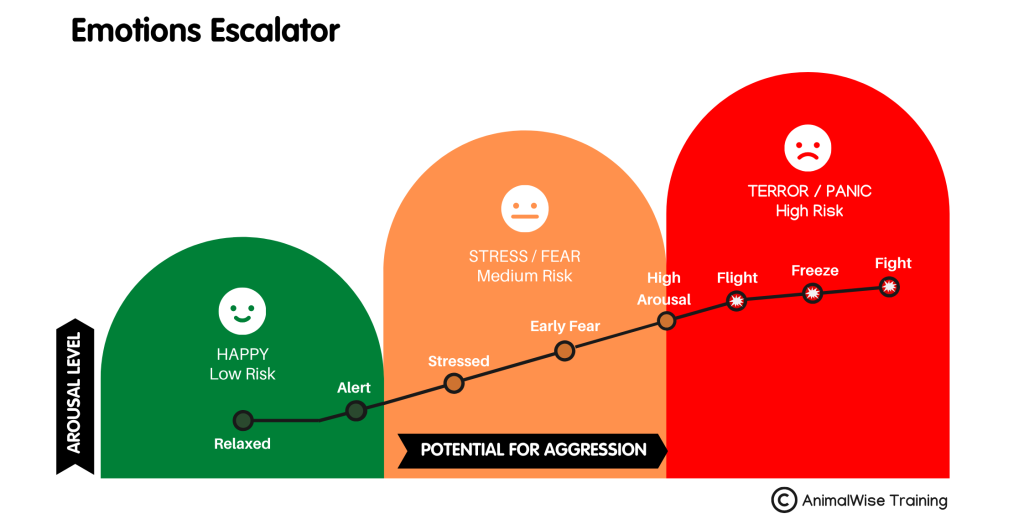
Every interaction — from approaching a cage to scanning for a microchip — should involve watching for small but meaningful changes such as:
- Increased body and facial tension
- Shifts in ear or whisker position
- Tail lowering
- Eye shape changes
- Fidget or displacement behaviours
- Stiffening, stillness, or intense staring
Handlers who spot these early patterns can pause, adjust the environment, cover carriers, give space, or use treats and time to prevent escalation.
It is far safer and kinder to interrupt stress early than to react to aggression later.
Common Escalation Signs
For the purposes of this blog, we will focus on the more commonly observed physical signs of escalation in cats. More subtle and nuanced behaviours are explored in greater depth in our AnimalWise Training courses.
Just as in dogs, cats move dynamically up and down the Emotions Escalator depending on their arousal level, perceived threat, and previous learning. Each cat in each new context is unique in terms of the combination of signs they display as they escalate in arousal level.
Green zone – Low risk
Cats in the Green Zone exhibit relaxed or alert signs, showing loose and fluid body movements and soft facial expressions, with soft eyes and brows, and loose lips. Their tail may rise up vertically with a curve at the tip in a friendly greeting.
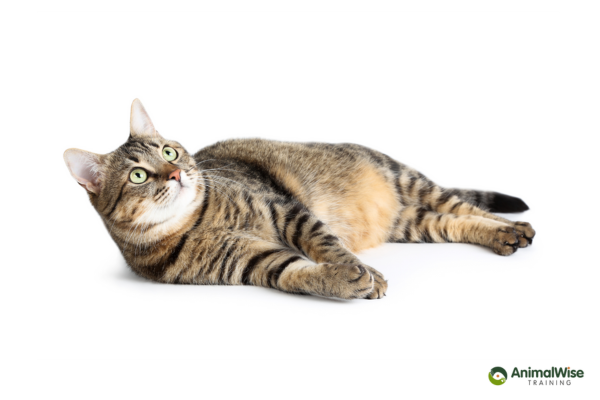
These signs indicate low risk for handlers, though cats can shift quickly into increased stress if the environment changes or if they perceive a threat.
Orange zone – Medium risk
As cats cross over into the Orange Zone, we begin to see mild stress signs. These appear subtle at first—lip licking, blinking, looking away, or mild body tension. The head may lower ever so slightly, and the tail may sit closer to the body. These early signs often precede more noticeable indicators.
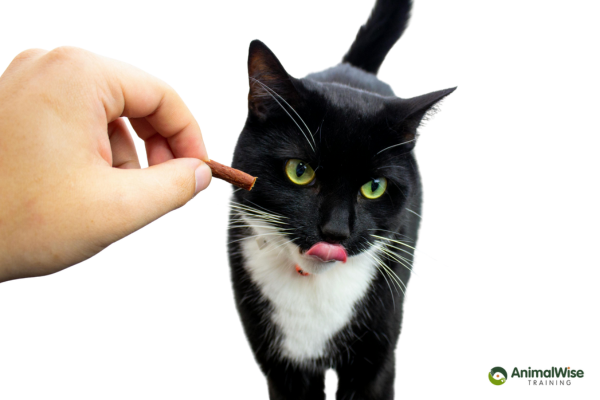
As stress increases, moderate stress signals becomes more apparent. We see clearer facial tension: eyes may squint, brows may furrow, lips may tighten, and whiskers may straighten. The tail is often low or closer to the body.
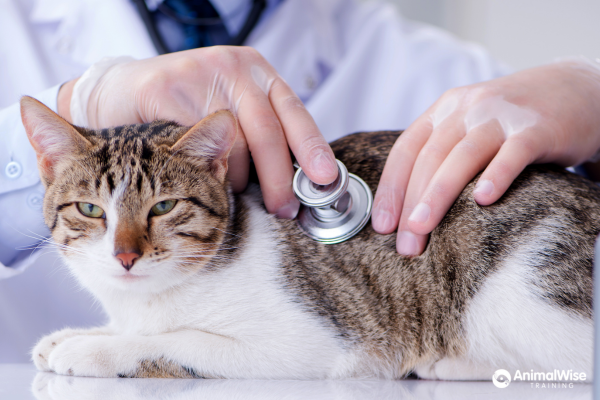
Similar to dogs at this level, fiddle or fidget signs, also known as displacement behaviours (stress behaviours that appear out of context) begin to emerge. This includes lip licking, blinking and yawning as well as sudden grooming, scratching, sniffing, or sneezing.
As cats ascend further within the Orange Zone, early fear signs begin to appear. The body and neck may lower slightly, pupils become moderately (but not fully) dilated, and the cat may attempt to move away in a measured, controlled manner. Whiskers may pull back, and ears often shift further to the side. Dogs at this early fear level, may show a series of conflict avoidance (or appeasement) behaviours, thought by many to be a function to diffuse tense situations by communicating that “I am no threat”. Cats appear to be far less developed in their repertoire of ritualised conflict diffusing behaviours, relying more on avoidance wherever possible, and red zone behaviours like hissing and swatting when hiding or retreating is not an option.
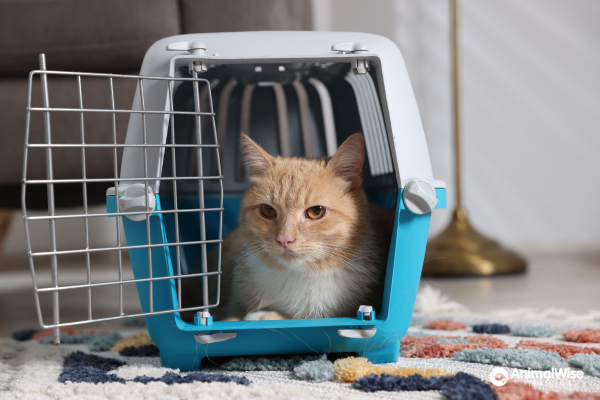
At the upper margin of the Orange Zone, we see early high arousal. The cat’s posture becomes more tense, pupils dilate further, and whiskers shift forward and become splayed out in a more pronounced manner. These signs lie just below the Red Zone and although the cat is not usually staring intensely at the handler, they mark a significant escalation in risk.
Red zone – High risk
As cats cross over into the Red Zone, high arousal warning signs becomes clearer and carry a heightened likelihood of aggression. Although we haven’t yet seen the signs of hissing, spitting, swiping or swatting that are associated with fight, we start to see pronounced stiffening of the body, intense staring at the perceived threat, dilated pupils, and whiskers that are sharply forward and splayed.
The very tip of the tail often flicks quickly from side to side, as a final last-ditch warning. Bear in mind, that tail tip flicks can also occur at lower levels of the Escalator, so must be assessed in conjunction with body tension and context. The overall body posture may appear “awkward”, often due to leaning or contorting in a readiness for sudden movement.

At this stage, cats are poised to adopt one of three core responses: flight, freeze or fight.
Flight involves panic-driven attempts to escape—bolting or scrambling to flee. The tail may appear bottle-brushed, and the ears flatten back.
Freeze presents as total body stiffness and stillness. The cat often crouches low or flattens their body and pin back their ears. Despite appearing motionless, the freeze response carries a significant risk of sudden fight behaviour.
Fight often occurs when the cat feels cornered with no remaining options. Two extremes of postures are seen: backward and forward.
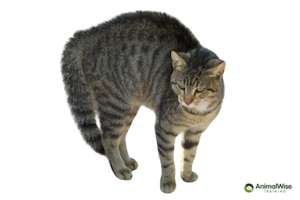
Forward fight is marked by an arched back, raised fur, forward ears, and tiptoe stance.
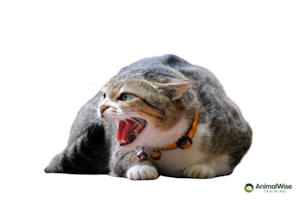
Backward fight shows crouching, tail pinned in tight to the body or sometimes thrashing from one side of the body to the other.
Whether the presentation is forward or backward, the hallmark fight signs of growling, hissing, spitting or swatting are hard to miss.
Cats rarely show all the possible signs in their progression in arousal level and may skip entire sections of the Emotions Escalator. Some cats may move directly from showing stress signs to high arousal signs; others may jump from early fear signs straight to fight signals. Recognising the early Orange Zone signs is therefore essential, as it offers the greatest opportunity to intervene safely and de-escalate before red-zone behaviours emerge.
The Handler’s Role is to Monitor Constantly
A handler’s role is to constantly monitor the cat’s body language to identify the earliest signs of stress or fear, well before the cat approaches the red zone. Cats often escalate quickly and jump signals, making the subtle early indicators such as changes in facial tension, whisker position, ear posture or body tone especially important to notice.
Early identification of these signs creates an opportunity to pause, identify the source of discomfort, and adjust the environment or handling approach to de-escalate the situation. This is proactive risk management in practice and is central to maintaining safety and welfare.
The Emotions Escalator provides everyone working with cats a practical framework for continuously assessing risk and making informed, proactive decisions during handling.
Reading in Context: The Missing Piece
Cat body language cannot be interpreted in isolation. To understand what a cat is communicating, handlers must consider the full context in which behaviours are occurring.
This means assessing the entire environment: smells, sights, sounds, surfaces, proximity to other animals, and sudden or unpredictable movements. Social context also matters, including the presence of unfamiliar people, the approach being used, and whether the cat feels it has a safe escape option.
A cat’s history whether known or unknown, can greatly influence how it responds to handling. Previous trauma, limited socialisation, fear of restraint or negative experiences with handling (or in enclosed spaces) all shape the cat’s perception of current events.
Unmet needs such as hunger, illness, pain, fatigue, overstimulation or confinement stress can also amplify body language signals.
Common triggers for feline fear and aggression include unfamiliar people, dogs nearby, loud noises, handling that removes choice or control, and strong or unfamiliar smells. By identifying and adjusting these environmental stressors where possible, handlers can prevent escalation before it occurs. Low-stress and fear-free handling techniques further reduce the need for restraint, one of the most significant triggers for aggression in cats.
Core Observation Skills for Professionals
Certain aspects of feline body language deserve particular focus, as they offer valuable insight into the cat’s emotional state.
1. Body tension
Body tension is one of the most reliable indicators of rising arousal but can surprisingly take some practice to fine tune as a reading skill. Cats may shift from loose, flowing movement to tighter, more compact and awkward postures as their emotional state escalates. These changes can be subtle and vary between individuals, requiring practice and calibration among team members.
2. Facial tension
Facial tension provides another clear window into the cat’s internal state. Small changes in lip and muzzle tension, furrowing around the brows, ear and whisker position, and overall facial tone offer meaningful clues, long before overt aggression appears.
3. Ears
Cat ears are much more uniform in size, shape and range of movement compared to dogs, making them much easier to interpret. As arousal level increases, we see shifts from neutral or forward facing ears to sideways (“airplane ears”), then backward or flattened. Cats make these transitions quickly, so continuous monitoring is essential.
4. Tail
The tail can be misinterpreted in cats, much like it can be in dogs, and must always be interpreted in combination with the rest of the body. However, generally a lowered or tightly wrapped tail indicates fear; a small tip flick suggests rising arousal; and a thrashing tail signals that the cat is entering the red zone.
No single behaviour, whether a tail flick, lip lick, whisker shift or ear movement, can accurately indicate a cat’s place on the Emotions Escalator. These cues must be integrated with the cat’s overall posture, facial expression and the context in which the behaviour occurs.
Body language is fluid and can change rapidly, requiring handlers to continuously absorb and interpret new information. The Emotions Escalator offers a fast, accessible framework for this dynamic risk assessment.
Why Mastery Matters
For professionals, proficiency in reading feline body language is not just about understanding cats, it is about creating safe, low-stress environments where animals and people are protected. Early recognition of escalation prevents injuries and reduces fear, stress and panic in cats navigating unfamiliar or challenging environments.
Mastery of these skills supports safety, enhances welfare, and reflects professional competence. The more skilled handlers become, the more they understand how nuanced, individual and fast-changing feline communication can be. Reading body language is not a checklist; it is a dynamic pattern that requires attentive, real-time interpretation to maintain a safe work environment.
To find out how we can help your team safely work with dogs and cats, contact us to learn more about our workplace induction, fast-tracked behaviour and safe animal handling courses.
Click HERE for more information | Call (03) 9061 9108 | Contact us HERE