
A few seconds can tell us a lot about whether a dog wants physical contact.
In Part 1 of this series, we looked at why an animal approaching us does not necessarily mean they want to be touched.
A dog may approach because they are curious, want to investigate us, are interested in something we have, or simply want to be nearby. Even sniffing our hand or clothing does not necessarily mean they are inviting physical contact.
So, how can we find out whether a dog genuinely wants to be touched?
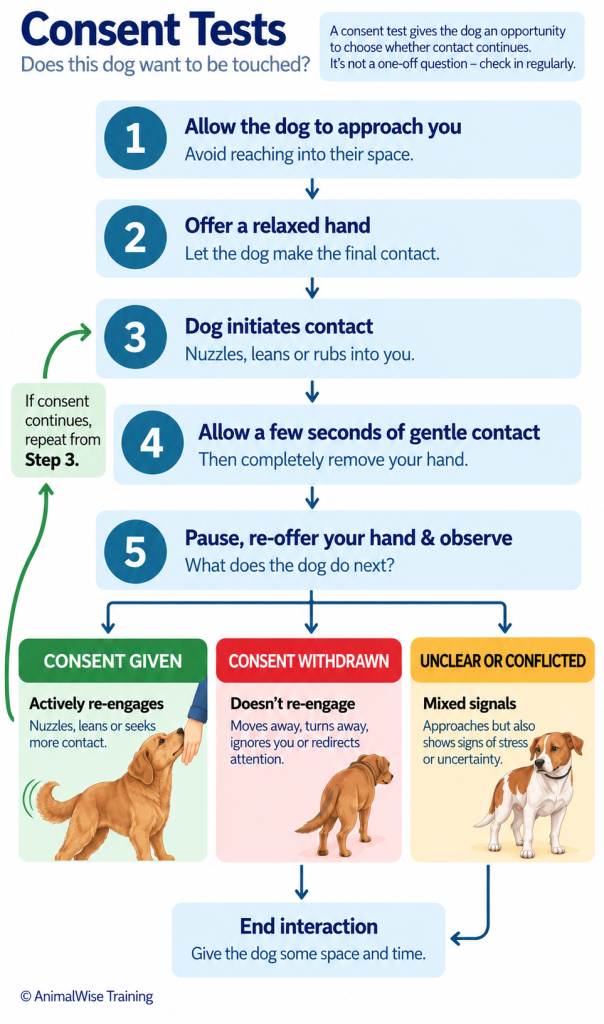
A simple consent test gives the dog an opportunity to initiate contact and, importantly, to choose whether that contact continues.
Does this dog need to be touched?
Before conducting a consent test, it is worth asking a more fundamental question: do we need to touch this dog at all?
If there is no need for physical contact, allowing a dog to approach, investigate us and move away again without attempting to touch them may be the most appropriate interaction. We might also choose to toss treats away from ourselves, rather than using food to encourage the dog closer.
In professional animal handling, however, there will be times when some physical contact is required — for example, before scanning a dog for a microchip or conducting a physical examination. In these situations, a consent test can be a useful way to begin the interaction and find out how the dog feels about initial social contact before progressing further.
Importantly, a dog choosing to engage in that initial contact does not mean they have consented to everything that follows. Their emotional state and body language still need to be continually assessed as the interaction progresses.
Before you touch the dog
A consent test starts before we put our hands on the dog.
Where possible, allow the dog to approach you rather than moving towards them or reaching into their space. Keep your body relaxed and positioned side-on rather than facing the dog directly. Avoid staring directly at the dog’s face or eyes; keeping your gaze soft and somewhat averted can help make the interaction less confronting.
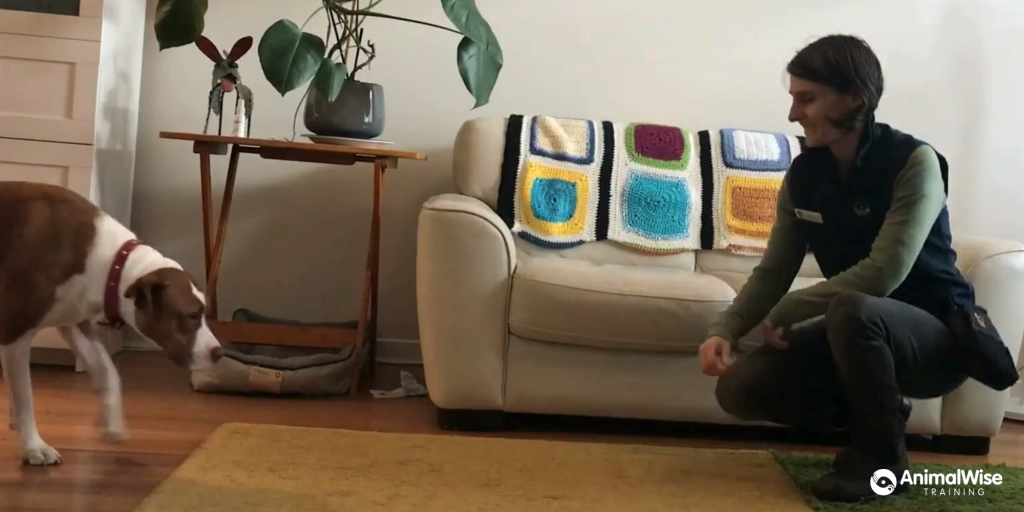
If the dog is familiar to you, you may choose to crouch down to avoid looming over them and appear less daunting. I do this in the demonstration video accompanying this article, while being careful to keep my gaze averted rather than looking directly into the dog’s face or eyes.
However, with an unfamiliar dog, it is often safer to remain standing. This is particularly important in confined spaces, or when the dog is restrained on a lead and cannot easily move away. Crouching brings our face closer to the dog’s face and can leave us in a less favourable position if their behaviour changes suddenly.
It is also safest not to attempt a consent test or initiate physical contact with an unfamiliar dog in a confined space. A dog who cannot easily increase distance may feel trapped, and this can lead to a rapid increase in arousal in some dogs.
Choice only works when the dog has a genuine opportunity to move away.
Let the dog make the final approach
If the dog chooses to approach, offer a relaxed hand without reaching into their space. This might be gently by your side if the dog is already very close to you, or a little further away from your body if they are further away. Keeping your hand relaxed and facing downwards, with the back of your hand towards the dog, may also be less confronting for many dogs than presenting an open, upward-facing palm.
Then wait.
The important part is that the dog makes the final contact with your hand.
A dog who wants physical contact may touch or nuzzle your hand, rub against you, lean into you or move their body along you. This is different from simply standing nearby or sniffing you.
Remember: proximity is not necessarily an invitation to touch.
Touch briefly — then completely remove your contact
If the dog initiates contact and their body language remains relaxed, you can respond with gentle physical contact.
Where possible, allow the dog’s behaviour to guide the location and nature of the contact, while keeping your touch gentle and flowing.
For many dogs, less intrusive areas to begin contact include under the chin and around the side of the neck or shoulder. Try to avoid reaching over the dog’s head or placing your hand over the top of their body, as well as repetitive “up and down” patting where the hand repeatedly comes away from and back onto the dog’s body.
After a few seconds of gentle contact, completely remove your hand from the dog.
This is an important part of the consent test. Rather than simply pausing while your hand remains on the dog, removing physical contact gives them a genuine opportunity to make another choice. Pause, assess their body language and, if appropriate, re-offer your relaxed hand.
Then watch what happens next.
What does consent given look like?
If the dog wants further contact, we are looking for them to actively re-engage after we have removed our hand.
They may:
- move back towards your hand or body;
- nuzzle or nose your hand;
- lean into you;
- rub their body against you; or
- position their body to invite contact in a particular area — for example, pushing their rump back towards you.
These behaviours should be considered alongside the dog’s overall body language. We would ideally also see a soft, relaxed body and face rather than tension or other signs of stress.
If the dog actively re-engages, gentle contact can resume.
After another short period, remove your contact again and reassess.
This is not a question we ask once.
Consent can be given repeatedly — and it can also be withdrawn at any point.
What does consent withdrawn look like?
Consent being withdrawn does not necessarily look dramatic.
A dog does not need to growl, snap or walk away before we recognise that they no longer want physical contact.
Sometimes it is as simple as the dog not re-engaging.
They may move away, turn their head or body away, or disengage from you altogether.
Very commonly, they may simply ignore you.
A dog who had previously been actively seeking contact might instead begin sniffing the ground, look with interest towards something elsewhere in the environment, or otherwise direct their attention away from you.
They may also show more subtle signs of increasing stress or discomfort, such as lip licking, yawning, lifting a front paw, becoming more tense or still, or doing a “shake off”.
If the dog does not choose to re-engage, we do not need to keep asking.
Their answer has changed.
What if the dog’s answer is unclear?
Dogs do not always give us a neat “yes” or “no”.
Sometimes we see conflicting behaviour.
A dog might approach us while also lip licking. They might move towards a hand but keep their body or tail lowered. They may lean forwards and then retreat, yawn, or become tense.
This tells us something important: the dog may have competing motivations.
They might be interested in us while simultaneously feeling uncertain about physical contact. They might want proximity without wanting to be touched. Food, familiarity, curiosity or previous learning may also influence their decision to approach.
This is why approach alone should never override the rest of the dog’s body language.
Where the response is conflicted or unclear, the safest interpretation is not to assume consent. Give the dog more time and space rather than proceeding with physical contact.
When “yes” becomes “no”
One of the most useful things about repeating a consent test is that it allows us to recognise when the dog’s preference changes.
A dog may actively re-engage after the first pause.
And the second.
And the third.
Then, after the next time we remove our hand, they may turn away, begin sniffing the ground, yawn or simply ignore the re-offered hand.
The video below demonstrates this with Bug. She repeatedly chooses to re-engage — including positioning her rump towards me to solicit further contact — before eventually yawning and then choosing not to re-engage when my hand is offered again.
This does not mean the consent test has failed.
It means it has worked.
The dog has been given an opportunity to tell us they have had enough, and we have recognised their communication before they need to make it stronger.
This is particularly important because the amount and type of contact a dog enjoys can vary. A dog may enjoy brief gentle contact under their neck but not prolonged stroking. They may invite contact around their shoulder but move away when someone reaches towards another part of their body. Their preference may also differ between people, environments and days.
Our job is not to persuade the dog to keep saying yes.
It is to notice when their answer changes.
A small interaction with important consequences
A consent test takes only seconds.
But those few seconds give us valuable information about how the dog is feeling and whether they genuinely want physical contact to continue.
Rather than assuming that approach means permission to touch, or that remaining still means a dog is comfortable, we can give them a genuine opportunity to participate in the interaction.
For animal handling professionals, this is another way we can respond to communication early — before subtle discomfort needs to become stronger behaviour.
Offer the opportunity. Remove contact. Pause. Observe. Then let the dog’s behaviour tell you what happens next.